
On this page
Legislative framework
A designated area migration agreement (DAMA) is an overarching labour agreement in place for a particular region of Australia. The process largely sits outside of a legislative framework, with most requirements outlined under policy only. It is a formal agreement between the Australian Government and a regional, state or territory authority.
Migration Act 1958 (the Act) and Migration Regulations 1994 (the Regulations) and associated administrative processes.
The Regulations do, however, set out the requirements that are required to be met where TSS, ENS or SESR nomination or visa applications are lodged under a labour agreement.
In addition, there are provisions in the Act and Regulations that define the terms ‘Work Agreement’ (WA) and ‘Labour Agreement’. The Regulations also include limited provisions regarding requirements for entering into a WA.
As outlined in Regulation 2.76, a Work Agreement is a type of LA. It must:
- be between:
- the Commonwealth, as represented by the Minister, or by the Minister and one or more other Ministers; and
- a person*, an unincorporated association or a partnership; and
- be a LA that authorises the recruitment, employment, or engagement of services of a person who is intended to be employed or engaged as a holder of a TSS visa; and
- be in effect (i.e. signed by all parties).
It provides access to more overseas workers than the standard skilled migration program. DAMAs operate under an agreement-based framework, providing flexibility for regions to respond to their unique economic and labour market conditions.
Individual DAMA labour agreements are between the Australian Government and endorsed employers/businesses operating within the relevant designated region. They:
- are generally in effect for five years, and
use the subclass 482 Temporary Skills Shortage (TSS), subclass 494 Skilled Employer Sponsored Regional (Provisional), and subclass 186 Employer Nominated Scheme (ENS) visa programs.
Application process and how to apply for the Northern Territory Designated Area Migration Agreement.
What is a DAMA?
A Designated Area Migration Agreement (DAMA) is an agreement between the Australian Government and a designated area. Through an agreement-based framework, it provides flexibility for states, territories or regions to respond to their unique economic and labour market requirements.
The Goulburn Valley (GV) region has negotiated a DAMA to include occupations and conditions that assist our region in addressing acute labour shortages. Under this framework, employers in the GV area who are experiencing skills and labour shortages can apply for endorsement to enter into a DAMA labour agreement. Compared to the standard skilled visa program, this agreement enables employers to sponsor skilled and semi-skilled overseas workers with more flexible requirements.
DAMA’s ensure employers recruit Australian citizens and permanent residents as a first priority and then recruit overseas workers to fill the gaps where needed.
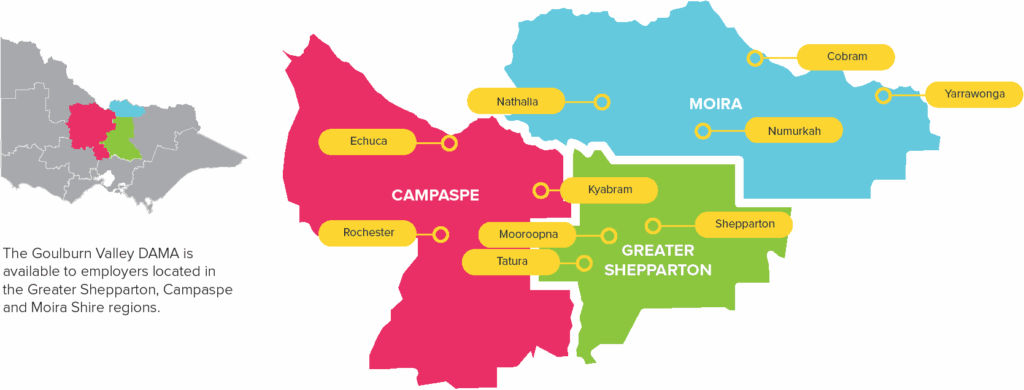
The GV DAMA is a skilled migration program that is tailored to the needs of the Goulburn Valley (GV) Region, being the Greater Shepparton, Campaspe and Moira Shire areas. The GV DAMA provides flexibility and certainty for both employers and workers, including;
- The ability to have occupations added (or removed) based on local demand and evidence;
- Semi-skilled as well as skilled occupations (Skill Levels 1-5);
- Access to well-defined permanent visa pathways for all occupations in Skill Level 1-5;
- Access to age concessions of 55 or 50 (depending on occupation) rather that the general age limit of 45 applying to standard migration pathways;
- Multiple visa options – Temporary Skill Shortage (TSS), Employer Nomination Scheme (ENS) (providing the qualifying time has been met) or Skilled Employer Sponsored Regional (Provisional) (SESR), (that provides a pathway to permanent residence under the Permanent Residence Skilled Regional (PRSR));
- Concessions to work experience requirements, compared to those in standard skilled migration pathways;
- Salary concessions for lower skilled occupations;
- English language concessions for numerous occupations;
Concessions
SALARY (TSMIT) CONCESSION
An employer has to show that the salary offered to a prospective overseas worker is at least what an Australian citizen or permanent resident could expect doing the same job in the same location.
There is also a minimum threshold that must be paid. The threshold, known as the Temporary Skilled Migration Income Threshold (TSMIT).
Refer to the Department of Home Affairs Salary requirements to nominate a worker for more detailed information on AMSR and TSMIT requirements.
Concessions to TSMIT are available for employers for the occupations listed in the Table of Approved Occupations. There must be a strong business case provided to support a TSMIT concession.
For the concessional occupations, an employer must provide the overseas worker with an amount of annual earnings which is equal to or greater than both the *Annual Market Salary Rate and **reduced TSMIT.
* ‘Annual Market Salary Rate’ has the same meaning as in the Migration Regulations. It is determined in accordance with the method for determining the Annual Market Salary Rate for an occupation nominated under section 140GB of the Migration Act or an occupation in relation to which a position is nominated under regulation 5.19 of the Migration Regulations.
* ‘Reduced TSMIT’ means 90% of TSMIT.
ENGLISH LANGUAGE CONCESSION
English language concessions are available for the occupations listed in the Table of Approved Occupations. Equivalent results in the following English tests are also acceptable:
- Occupational English Test (OET)
- Test of English as a Foreign Language internet-based test (TOEFL iBT)
- Pearson Test of English (PTE) Academic test; or
- Cambridge English: Advanced (CAE) test.
Approved Occupations
The table shows the occupations that are eligible for sponsorship under the GV DAMA, respective skill level, skills concessions, TSMIT (Temporary Skilled Migration Income Threshold) concessions, English language concessions and eligibility for pathway to permanent residency.
The tasks and skill requirements for all these occupations are outlined in ANZSCO.
GV DAMA Approved Occupation List