
On this page
- Legislative framework
- Designated Area Migration Agreement (DAMA)
- The South Australian Government has entered into two DAMAs
Adelaide Technology and Innovation Advancement Agreement
South Australian Regional Workforce Agreement
- Concessions
Work Experience Concession & Occupation Lists
Temporary Skilled Migration Income Threshold (TSMIT) Concession
English Language Concession
Age Concession and Permanent Residence Pathway
Legislative framework
A designated area migration agreement (DAMA) is an overarching labour agreement in place for a particular region of Australia. The process largely sits outside of a legislative framework, with most requirements outlined under policy only. It is a formal agreement between the Australian Government and a regional, state or territory authority.
Migration Act 1958 (the Act) and Migration Regulations 1994 (the Regulations) and associated administrative processes.
The Regulations do, however, set out the requirements that are required to be met where TSS, ENS or SESR nomination or visa applications are lodged under a labour agreement.
In addition, there are provisions in the Act and Regulations that define the terms ‘Work Agreement’ (WA) and ‘Labour Agreement’. The Regulations also include limited provisions regarding requirements for entering into a WA.
As outlined in Regulation 2.76, a Work Agreement is a type of LA. It must:
- be between:
- the Commonwealth, as represented by the Minister, or by the Minister and one or more other Ministers; and
- a person*, an unincorporated association or a partnership; and
- be a LA that authorises the recruitment, employment, or engagement of services of a person who is intended to be employed or engaged as a holder of a TSS visa; and
- be in effect (i.e. signed by all parties).
It provides access to more overseas workers than the standard skilled migration program. DAMAs operate under an agreement-based framework, providing flexibility for regions to respond to their unique economic and labour market conditions.
Individual DAMA labour agreements are between the Australian Government and endorsed employers/businesses operating within the relevant designated region. They:
- are generally in effect for five years, and
use the subclass 482 Temporary Skills Shortage (TSS), subclass 494 Skilled Employer Sponsored Regional (Provisional), and subclass 186 Employer Nominated Scheme (ENS) visa programs.
Application process and how to apply for the Northern Territory Designated Area Migration Agreement.
Designated Area Migration Agreement (DAMA)
The DAMAs enable South Australian employers to sponsor skilled overseas workers for positions they are unable to fill with local workers. Employers experiencing skills and labour shortages can apply for endorsement to enter into a DAMA labour agreement.
The following diagram outlines the end-to-end process for applying for this visa. As an employer, you are first required to seek endorsement from the DAR (Skilled & Business Migration).
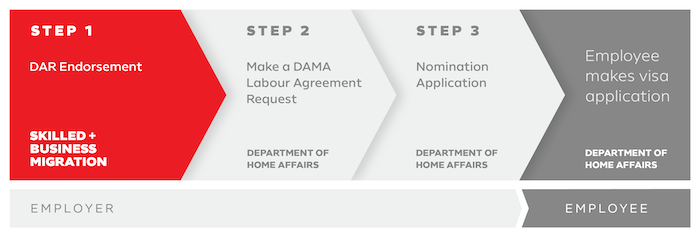
This enables them to sponsor skilled and semi-skilled overseas workers with more flexible requirements than are available via the standard skilled visa programs.
The South Australian Government has entered into two DAMAs:
Adelaide Technology and Innovation Advancement Agreement
This agreement focuses on Adelaide’s high-tech growth industries including defence, space, technology and advanced manufacturing industries. The Adelaide City Technology and Innovation Advancement Agreement is the Designated Area Migration Agreement (DAMA) covering metropolitan Adelaide.
South Australian Regional Workforce Agreement
This agreement focuses on South Australia’s regional high growth industries including agribusiness, forestry, health and social services, tourism and hospitality, construction and mining. The South Australian Regional Workforce Agreement is the Designated Area Migration Agreement (DAMA) covering the entire state of South Australia.
Concessions
Concessions vary from DAMA agreement and by occupation and can include:
- Work Experience
- Temporary Skilled Migration Income Threshold (TSMIT)
- English language
- Permanent Residence Pathway and Age
It is important to check your occupation for available concessions.
Work Experience Concession
For many occupations on the Combined List of Eligible Skilled Occupations concessions may be available to the work experience normally required of these visa subclasses. Please check the occupation list for eligibility.
Temporary Skilled Migration Income Threshold (TSMIT) Concession
Employers can access the TSMIT concession for eligible occupations.
Reduced TSMIT means 90% of TSMIT and the following concession types are available.
Earnings include guaranteed overtime, where consistent within industry practice and within National Employment Standards.
The business must show that TSMIT concessions will not undermine Overseas Worker’s ability to support themselves or lead to exploitation.
| Type 1 | Type 2 | Type 3 | |
|---|---|---|---|
| Monetary Earnings | At least Reduced TSMIT | At least Reduced TSMIT less non-monetary earnings (other) | At least Reduced TSMIT less non-monetary earnings (food & board) |
| Non-monetary earnings (food & board) | Nil | Nil | Cannot exceed published SA homestay rates |
| Non-monetary earnings (other) | Nil | No more than 10% of Reduced TSMIT | Nil |
| Total Annual Earnings | At least Reduced TSMIT | At least Reduced TSMIT | At least Reduced TSMIT |
English Language Concession
Under the DAMA, nominees (visa applicants) can access the English concession for eligible occupations.
SESR (494) and SID (482) concession:
- IELTS score of 5.0 overall (or equivalent), and minimum of IELTS score 4.0 (or equivalent) for individual bands, for specified occupations, or
- IELTS score 4.5 overall (or equivalent), and minimum of IELTS score 4.0 (or equivalent) for individual bands, for specified semiskilled occupations for positions in outer regional South Australia.
ENS (186) concession:
- IELTS score 5.0 overall (or equivalent), and minimum of IELTS score 4.5 (or equivalent) for individual bands, where specified in the DAMA occupation list.
IELTS means the International English Language Testing System or the equivalent in another accepted English language test.
Other accepted English language tests are:
- Occupational English Test (OET)
- Test of English as a Foreign Language internet-based test (TOEFL iBT)
- Pearson Test of English (PTE) Academic test (home version not acceptable)
- Cambridge English: Advanced (CAE) test
Note: Concession not available if registration or licensing requires a higher level of English.
Age Concession and Permanent Residence Pathway
For workers on a Skills in Demand (SID) subclass 482 visa, a permanent residence pathway may be available through the Employer Nomination Scheme (ENS) Subclass 186 visa program.
While the Skills in Demand (SID) subclass 482 visa does not have an age limit, the permanent ENS visa (subclass 186) requires applicants to meet the age requirement at the time of nomination. Under DAMA, many occupations are eligible for age concession for ENS visa (subclass 186). For these occupations, the visa applicant must not have turned 55 years of age at time of ENS visa nomination.
For workers on a Skilled Employer Sponsored Regional (SESR) subclass 494 visa, an age concession may be granted for selected occupations. The visa applicant must not have turned 55 years of age at time of SESR visa nomination.
For SESR visa holders, a permanent residence pathway may be available through the Permanent Residence (Skilled Regional) subclass 191 visa. Refer to the Department of Home Affairs website.
Check the occupation list to see if your occupation is eligible for permanent pathway and associated age concession.
To apply for ENS (186 subclass) nomination endorsement and age concession requests, the employer will need to submit a Variation Request.